AI Factories · InHome engineering note
How a governed AI work order reaches review
A practical boundary between model orchestration, human review and product release.
InHome Development · Limassol, Cyprus ·
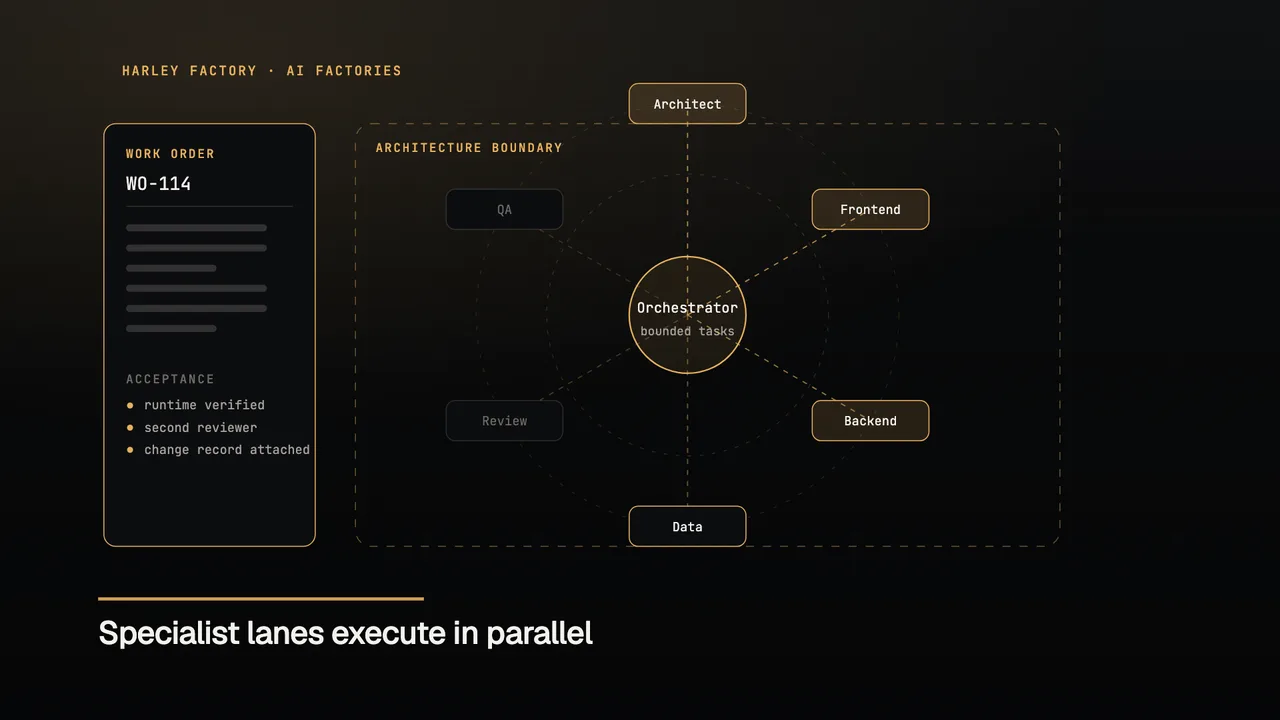
Start with acceptance, not an agent list
A software request often begins as a short sentence. Before selecting a model or asking agents to write code, the work order needs a scope, the behavior to deliver and an observable definition of done.
Harley Factory documents a product-engineering foundation around that idea. Its work-order, review and release boundaries keep the owner in control of what reaches users.
Route bounded work to specialist lanes
The orchestrator breaks the work into tasks whose boundaries can be inspected: architecture, implementation, browser behavior, tests and review. A model or tool is chosen for the task, rather than treating one model as the system architecture.
Each lane returns an artifact to the same work order. The result is useful only if its changes and assumptions can be read by the next lane; a confident summary is not a substitute for the code or runtime behavior.
Make the return path visible
Review is independent of authorship. A finding returns to the author for correction, then the change is exercised again. This is the key difference between an agent demo and a delivery workflow that a technical buyer can inspect.
Release remains an explicit decision after testing and owner acceptance. The business value is reviewable execution: the team can see what changed, what was tested and what still needs a person.