Real Estate Technology · InHome engineering note
Why property search starts with one record
The data decisions behind a property catalogue that brokers can use after a buyer enquires.
InHome Development · Limassol, Cyprus ·
The input is not the product
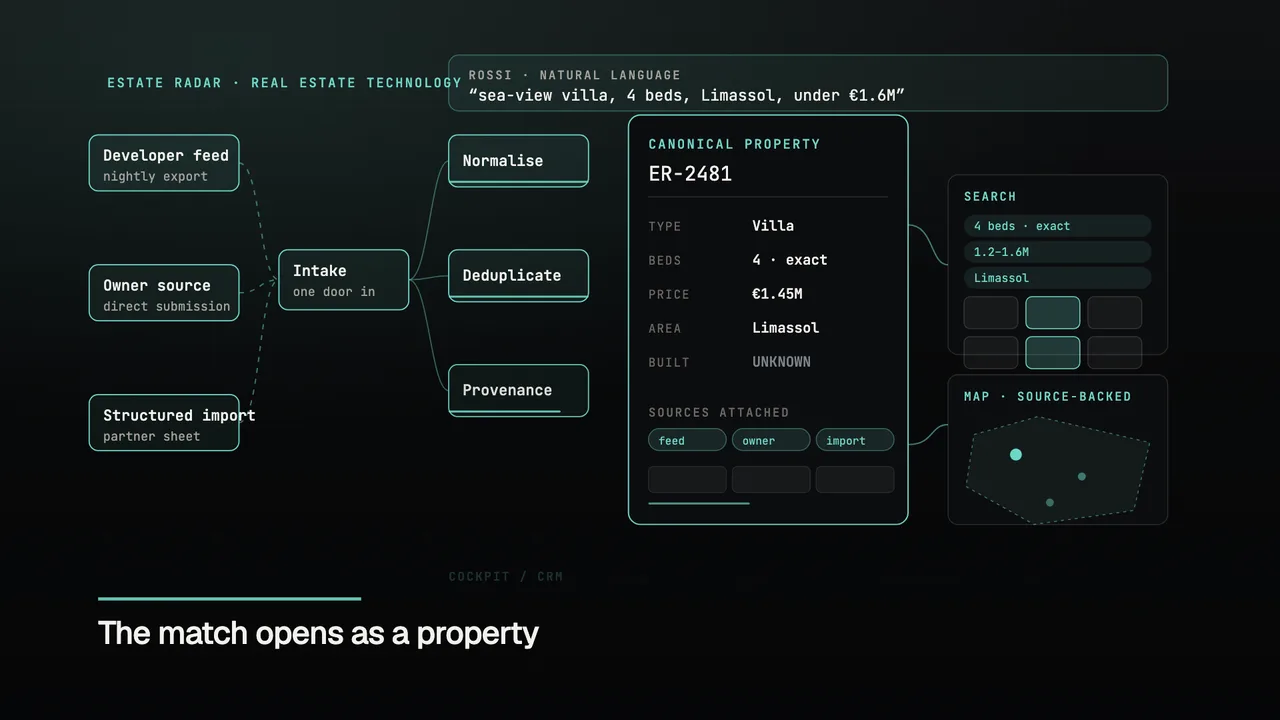
A Cyprus property can reach an agency as a developer feed entry, an owner submission or a manual import. Those inputs are not interchangeable: one may have a floor plan, another a price update, and a third a different spelling of the address.
Publishing each input directly makes the catalogue easier to fill but harder to trust. The first system job is to preserve where each fact came from while deciding whether two inputs refer to the same property.
Keep source and identity separate
The intake maps source fields into a common shape. A duplicate check links the submission to an existing canonical record when the property is already known. Provenance stays on the facts, so a later correction can be traced back instead of silently replacing a field.
That record is what the marketplace, exact-count filters and map read. The public interface is therefore a view of the operating database, not a second inventory maintained by hand.
The journey continues after search
A useful match opens a property detail and an enquiry. From there the person, lead and opportunity belong to the same operational thread in Cockpit/CRM. A broker can see which property started the conversation rather than reconstructing it from a separate form inbox.
AI assistance can help describe a buyer intention and surface matching records, while source review and customer decisions remain human responsibilities. The business effect is one coherent discovery and follow-up path.